
ARCHIVAL CASE FILE
ARCHIVAL ENTRY: AA-OH-1955-LFM
Title: The Loveland Amphibious Humanoid Phenomenon
Alternate Designations: Loveland Frog; Loveland Frogman; Frogman of Loveland
Classification Status: Open
Primary Location: Loveland, Ohio, United States
Date Range: 1955 – Present (intermittent)
Compiled By: The Anomalous Archivist
Last Reviewed: 2026-01-08
ABSTRACT / EXECUTIVE SUMMARY
This archival entry documents a series of anomalous encounters involving an upright, amphibious humanoid entity reported around Loveland, Ohio. Witnesses described a small, bipedal figure with frog-like features observed near waterways, roadways, and bridge structures.
The phenomenon is notable both for its longevity and recurring geographic specificity. Of note are several reports from credible witnesses, including law enforcement. Framed as local folklore, the similarity of descriptions across decades warrants formal archival preservation. This file records reported encounters, environmental context, and secondary effects, an archive of a repeating pattern over decades.
I. INITIAL MANIFESTATION
First Recorded Encounter:
- Date: March 1955
- Time: Approximately 3:30 a.m.
- Location: Riverside roadway near the Little Miami River
Witness Count: Single witness
Witness Profile: Adult male motorist; traveling alone
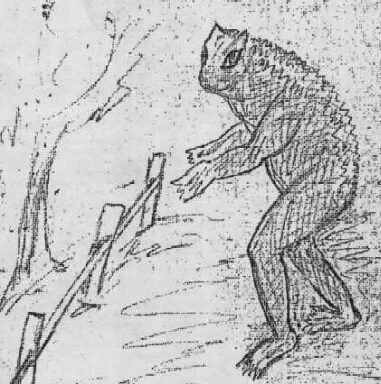
The earliest documented encounter occurred when a motorist driving along a rural road adjacent to the Little Miami River observed three figures standing upright on the roadside. The figures were described as approximately three to four feet tall, with leathery skin, squat bodies, and heads resembling a frog. The figures appeared to be interacting with one another before turning toward the vehicle.
Upon noticing the witness, the entities fled toward the riverbank. The witness did not pursue. The location was close to the water and featured minimal artificial lighting. The witness departed the area immediately and later reported the incident to local authorities. No physical traces were recovered.
II. PATTERN & ESCALATION ANALYSIS
Subsequent reports indicate recurrence rather than escalation.
Frequency: Rare; clustered by decade
Geographic Spread: Loveland and surrounding river corridors
Behavioral Repetition: Upright posture; rapid retreat; avoidance of prolonged contact
Escalation Indicators: Occasional display of objects or gestures
Psychological Effects: Shock; heightened vigilance; lingering unease
Later sightings maintained core descriptive elements: short stature, bipedal locomotion, frog-like facial structure, and proximity to water. The phenomenon appears geographically tethered to riverbanks, drainage systems, and bridge underpasses.
Unlike aggressive cryptid reports, the Loveland encounters typically involve brief observation followed by withdrawal. No verified attacks, pursuits, or injuries have been documented.
III. CORRELATED DISTURBANCES
Secondary disturbances are rare, but noteworthy.
Documented secondary disturbances include:
- Sudden silence of nearby wildlife
- Reflective eye-shine when exposed to light.
- Momentary disorientation
- Strong aversion responses from domestic animals
In several later accounts, witnesses reported dogs refusing to approach riverbanks or reacting aggressively toward unseen stimuli following encounters. No electrical interference or mechanical malfunction has been documented.
These disturbances generally coincided with sightings and did not persist beyond the immediate encounter.
IV. TERMINAL EVENT / DISAPPEARANCE
No terminal event has been identified.
The most prominent modern incident occurred in 1972, when a police officer reported observing a small humanoid figure near a roadway. The figure allegedly raised an object before fleeing toward the river. Subsequent investigation yielded no physical evidence. Official explanations later suggested the sighting may have involved an iguana, although no exotic animals were reported missing at the time. No amphibian or reptile species native to Ohio reach sizes similar to those reported in sightings.
Following periods of public attention, reports diminished but never ceased entirely. The absence of a definitive concluding event indicates dormancy rather than resolution.
V. EXPANDED PHENOMENA (IF APPLICABLE)
Some accounts intersect with broader anomalous themes.
Reported overlaps include:
- Proximity to unidentified lights near waterways
- Rumors of underground access points along riverbanks
- Repeated sightings near specific bridges
No verified documentation supports institutional involvement or containment; law enforcement observation was by chance. Cross-referencing reveals thematic overlap with other amphibious humanoid reports in North America, though no direct connection has been established.
The repeated association with waterways suggests environmental dependency.
VI. SKEPTICAL REVIEW & LIMITATIONS
Conventional explanations include:
- Misidentification of large amphibians or reptiles
- Escaped exotic pets viewed under stress conditions
- Hoaxes or exaggeration
- Expectation bias influenced by local legend
Skeptics note that Ohio does not natively host large amphibian or reptile species, weakening misidentification arguments. However, the lack of physical evidence, footprints, or biological samples limits formal investigation into the biological reality of the phenomenon.
Witness credibility varies. While some reports originate from law enforcement or sober adults, others rely on secondhand testimony. Temporal gaps between encounters further complicate pattern analysis.
VII. LEGACY & RECURRENCE INDICATORS
The Loveland phenomenon maintains a persistent presence in regional culture.
Indicators include:
- Continued reports into the 21st century
- Integration into local folklore and community identity
- Recurring media and investigative interest
Unlike more aggressive cryptid legends, this phenomenon persists as a low-intensity but enduring anomaly. Integration into the local economy and culture complicates identification of the anomaly as a biological reality rather than folklore. However, reports occasionally surface from individuals unfamiliar with earlier accounts, suggesting independent emergence and bolstering claims of a patterned anomaly.
VIII. ARCHIVAL ASSESSMENT
The Loveland amphibious humanoid phenomenon occupies an unresolved position between folklore and anomalous encounter. Its defining characteristics—bipedal movement, amphibious features, and geographic consistency—remain inadequately explained by conventional frameworks.
The absence of escalation, casualties, or physical evidence complicates classification but does not negate the significance of repeated, independent testimony. Whether the phenomenon represents misinterpretation, cultural persistence, or an undocumented anomaly remains undetermined.
IX. WORKS CITED
Keel, John A. Strange Creatures from Time and Space. Fawcett Gold Medal, 1970.
Radford, Benjamin, and Joe Nickell. “The Loveland Frog: Fact, Fiction, or Folklore?” Skeptical Inquirer, vol. 36, no. 3, 2012, pp. 34–39.
Clark, Jerome. Unexplained! Strange Sightings, Incredible Occurrences, and Puzzling Physical Phenomena. Visible Ink Press, 1999.
Ohio regional newspaper archives, Clermont and Hamilton counties, 1955–2005.
Documentation incomplete due to loss, suppression, or degradation of records.
ARCHIVAL NOTES
Multiple witness names withheld due to privacy concerns.
Cross-file similarity flag raised with amphibious humanoid reports in Kentucky and Pennsylvania.
[REDACTED BY ARCHIVAL AUTHORITY]
END OF FILE
 The Anomalous Archivist
Leave a comment