
ARCHIVAL CASE FILE
ARCHIVAL ENTRY: AA-MI-1887-DM
Title: The Michigan Canid Humanoid Phenomenon
Alternate Designations: Michigan Dogman; The Wexford County Dogman
Classification Status: Open
Primary Location: Northern Lower Peninsula of Michigan, United States
Date Range: 1887 – Present (intermittent)
Compiled By: The Anomalous Archivist
Last Reviewed: 2026-01-19
ABSTRACT / EXECUTIVE SUMMARY
This archival entry documents a recurring canid humanoid entity reported primarily in the northern regions of Michigan’s Lower Peninsula. Witnesses report a large, upright, bipedal canine-like figure, with reports dating back over more than a century. These reports describe consistent physical characteristics, behavioral patterns, and environmental effects across time and place. Sightings cluster geographically and increase notably during specific seasons.
The consistency of reports distinguish this case from isolated folkloric accounts, perhaps pointing to a physical reality underpinning sightings. However, an absence of physical evidence renders the entity unclassifiable under known zoological frameworks, the persistence of reports warrants archival preservation. This record then does not assert physical reality, but documents observable claims and disturbances associated with the Dogman phenomena.
I. INITIAL MANIFESTATION
First Recorded Encounter:
- Date: Summer 1887
- Time: Unspecified
- Location: Rural logging camp near Wexford County, Michigan
Witness Count: Multiple (exact number unknown)
Witness Profile: Adult male laborers (lumberjacks)
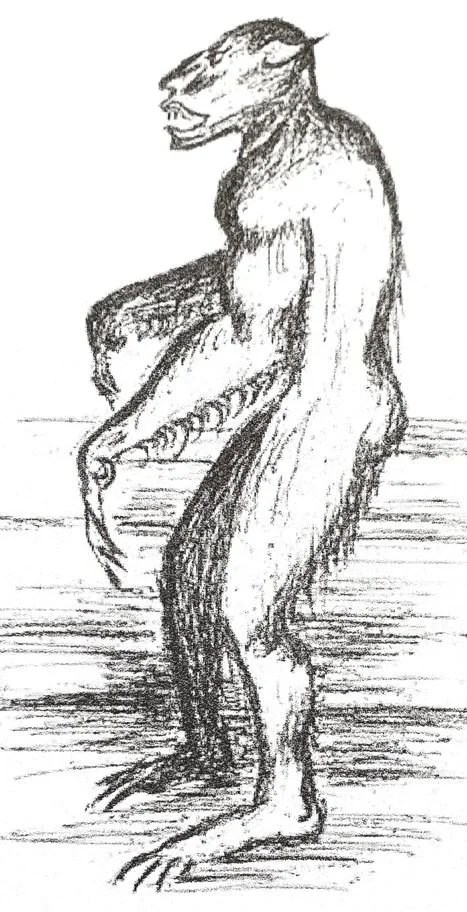
The earliest recorded account originates from a logging camp operating in what later became Wexford County. Workers reported a tall, canine-shaped figure moving upright on two legs near the periphery of the camp. Witnesses described the figure as being taller than average man, with broad shoulders, pointed ears, and a long snout consistent with a wolf or dog.
Environmental conditions were typical for late-summer Michigan forests: low light, heavy tree cover, and limited artificial illumination. Witnesses reported cessation of forest sounds immediately prior to the encounter. The figure was observed briefly before retreating into the trees. Immediate reactions included fear and disorientation. A small number of workers were frightened enough to leave the camp.
II. PATTERN & ESCALATION ANALYSIS
Subsequent reports demonstrate recurrence of sightings approximately every ten years; spikes in reported sightings occurred in 1938, 1967, 1987, and 1997. Note that additional reports exist outside these intervals, but these appear to be outliers.
Frequency: Sporadic, spiking approximately every decade.
Geographic Spread: Northern Lower Peninsula; scattered reports in western Upper Peninsula
Behavioral Repetition: Upright locomotion, silent observation, brief confrontations
Escalation Indicators: Increased proximity to vehicles and occupied dwellings in later decades
Psychological Effects: Acute fear responses; recurring dreams reported by some witnesses
The anomaly displays consistent morphology across unrelated witnesses: bipedal stance, digitigrade legs, canine head, and dark or gray fur. Behavior suggests awareness of human presence without overt aggression. No verified attacks are on record; however, reports indicate intimidation through posture, growling, or prolonged staring.
III. CORRELATED DISTURBANCES
Secondary effects frequently accompany Dogman sightings.
Documented disturbances include:
- Sudden, oppressive silence
- Unexplained electrical malfunctions in vehicles
- Disorientation and time-perception anomalies
- Unusual reactions from domestic animals (panic, refusal to exit vehicles)
Witnesses reported these effects immediately preceding visual contact. Animal behavior changes were consistently report, particularly in dogs, who exhibited fear responses disproportionate to typical wildlife encounters.
Several reports also mention a low-frequency growl described as “felt rather than heard,” suggesting possible infrasound effects. No instrumentation was present to verify.
IV. TERMINAL EVENT / DISAPPEARANCE
No definitive terminal event has been identified.
Notable cessation periods followed increased public attention, particularly after a surge of media interest in the late 1980s. Official explanations attributed sightings to hoaxes or misidentified bears or wolves. No verified casualties or structural damage have been linked conclusively to the phenomenon.
Pattern analysis indicates that heightened reporting often correlates with logging expansion, rural development, or recreational use of forested areas such as the Manistee National Forest. Therefore, it can be inferred that sightings could result from human incursion into Dogman territory.
V. EXPANDED PHENOMENA (IF APPLICABLE)
Some cases overlap with additional high-strangeness indicators.
Reported overlaps include:
- UAP in the form of lights in the sky observed prior to sightings
- Encounters with other unknown humanoid figures in surrounding areas.
- Alleged unofficial warnings from local authorities discouraging night travel
No verified documentation supports institutional interference. However, repeated anecdotal claims of report suppression or ridicule contributed to underreporting, particularly prior to the late 20th century.
Cross-referencing reveals similarities with other upright canid legends in North America, though no direct linkage has been established.
VI. SKEPTICAL REVIEW & LIMITATIONS
Conventional explanations include:
- Misidentification of black bears standing upright
- Escaped or feral canines viewed under stress conditions
- Folklore contamination influenced by regional storytelling
Psychological interpretations cite expectancy bias and environmental stressors common in isolated forest settings. Weaknesses in testimony include low-light conditions, lack of physical evidence, and reliance on memory recall.
However, skeptics acknowledge difficulty accounting for consistent anatomical descriptions and bipedal locomotion across independent witnesses separated by decades.
VII. LEGACY & RECURRENCE INDICATORS
The Michigan Dogman occupies a persistent place in regional cultural memory. Accounts continue into the 21st century, with reports submitted most often by hikers, hunters, and motorists.
Indicators suggest:
- Dormant periods followed by periods of activity
- Possible migratory behavior within forest corridors
- Continued presence in local oral tradition
Modern digital reporting platforms have increased visibility. However, hoaxes both practical and digital distort the signal to noise ratio, making true verification of reports difficult.
VIII. ARCHIVAL ASSESSMENT
The Michigan canid humanoid phenomenon remains unresolved. The absence of physical corroboration prevents definitive classification, yet the depth and descriptive consistency resist simple dismissal.
Patterns indicate an anomaly capable of evasion and environmental integration. Whether this reflects an undiscovered biological entity, a psychological construct reinforced by environment, or an unrecognized phenomenon is yet to be determined.
IX. WORKS CITED
Gagnon, Linda S. Haunted Michigan. Stackpole Books, 1999.
Taylor, John L. “Folklore and Fear in the American Midwest.” Journal of Regional Myth Studies, vol. 12, no. 3, 2004, pp. 44–61.
Bauer, Robert. “Cryptozoological Reports of Upright Canids.” North American Anomalies Review, vol. 7, 1995, pp. 112–130.
Local newspaper archives, Cadillac and Manistee regions, 1887–1997.
Documentation incomplete due to loss, suppression, or degradation of records.
ARCHIVAL NOTES
Several witness names withheld at request of reporting parties.
Cross-file similarity flag raised with upright canid reports in Wisconsin and Ohio.
[REDACTED BY ARCHIVAL AUTHORITY]
 The Anomalous Archivist
Leave a comment