
ARCHIVAL ENTRY AA-WV-1966-MM
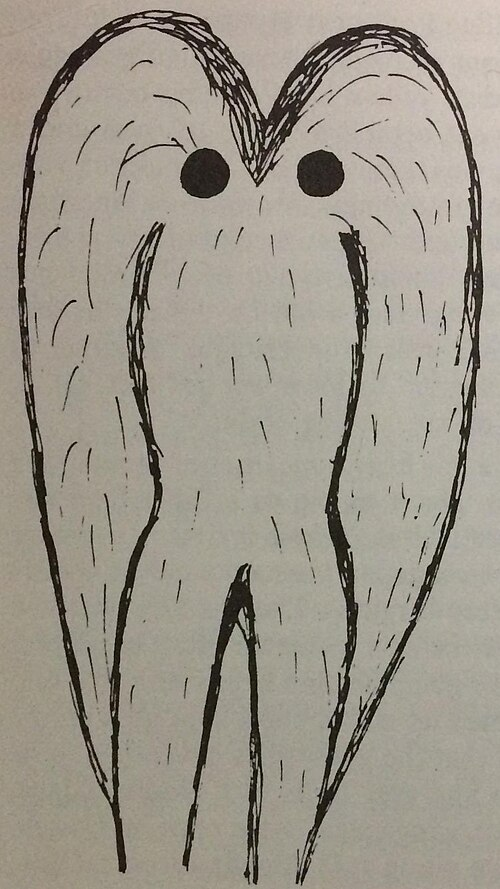
“The Point Pleasant Anomaly”
Some anomalies fade with time, while others refuse to remain buried. The entity popularly known as the Mothman belongs to the latter category. Its appearances were brief, and its purpose ambiguous, yet the consequences surrounding its manifestation were permanent.
This entry documents the Mothman not as mere folklore, but as a patterned anomaly: a phenomenon observed repeatedly, reported independently, and temporally linked to a specific event, in this case a catastrophic loss of life. Whether biological, psychological, or something else, the Mothman warrants preservation in the archive—not as entertainment, but as a warning.
I. Initial Manifestation Zone
All confirmed reports originate in and around Point Pleasant, West Virginia, a small river town situated at the confluence of the Ohio and Kanawha Rivers. Prior to 1966, the location had no notable history of anomalous events.
The first major incident occurred on November 12, 1966, within the derelict complex known locally as the TNT Area—an abandoned World War II explosives facility. Such locations feature frequently in anomalous case files: liminal spaces, scarred by both human industry and neglect.
Four witnesses reported encountering a towering, winged humanoid form. Descriptions were consistent across testimonies:
- Height exceeding six feet
- Large wings
- No visible neck or head
- Two luminous red eyes embedded high in the torso
The entity did not vocalize or otherwise attempt to communicate; it observed.
When the witnesses attempted to flee, the entity pursued their vehicle at speeds in excess of 90 miles per hour. This behavior could suggest intentional engagement rather than instinctual, territorial defense.
The archive flags this moment as Event Zero.
II. Escalation and Behavioral Pattern
Following Event Zero, reports increased in frequency. Witnesses described sightings along roadways, atop structures, and hovering silently over open ground. The entity exhibited no predatory behavior; there were no attacks nor physical confrontations. Instead, the sightings were characterized by presence—a deliberate act of being seen.
Secondary effects were also recorded:
- Electrical disturbances
- Radio interference
- Persistent feelings of dread and or “being watched”
Psychological impact was severe. Residents reported insomnia, recurring nightmares, and an acute sense of impending disaster. These symptoms appeared not only in witnesses, but also residents who had not directly observed the entity but were aware of the reports.
This suggests the Mothman is to some extent a memetic hazard—an anomaly whose effects propagate through awareness itself.
III. Terminal Event: Structural Failure and Loss of Life
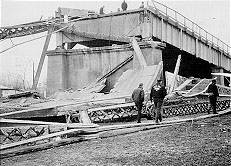
Public Domain, https://commons.wikimedia.org/w/index.php?curid=2500886
On December 15, 1967, the pattern concluded in tragedy.
The Silver Bridge collapsed during peak traffic, sending vehicles into the Ohio River below. Forty-six fatalities were confirmed. Recovery efforts extended for days.
In the weeks preceding the collapse, Mothman sightings diminished and then ceased entirely.
The correlation is not causation—but the archive does not ignore the convergence of events. The entity appeared, remained visible during a period of escalating dread, and vanished immediately prior to disaster. This sequence mirrors other documented “omen phenomena” across cultures and centuries.
Official investigations cited structural defects and metal fatigue. Engineering explains the physical cause of collapse, but does nothing to explain the anomalous events that preceded.
IV. Expanded Phenomena and High-Strangeness Contamination
The Mothman phenomena attracted investigator John Keel, whose findings broadened the scope of the anomaly significantly. Witnesses reported encounters with UAP (Unidentified Aerial Phenomena), cryptic phone calls, and individuals exhibiting unsettling behavior.
These figures—see the Men in Black—appeared in the community to discourage testimony while exhibiting behavior residents found bizarre and unsettling. One recurring presence, Indrid Cold, claimed non-terrestrial origin and spoke of human suffering with detached, clinical curiosity.
Keel proposed that the Mothman was not a biological organism but a manifestation vector—one expression of an unknown intelligence intersecting with human perception during a moment of instability.
The archive neither confirms nor dismisses this hypothesis. It includes this concept to note that anomalies often occur in clusters.
V. Rational Explanations and Archival Limitations
Skeptical analyses suggest misidentified owls, mass suggestion, and stress-induced hallucination/mass hysteria. Such explanations are entered into the record for the sake of completeness. They account for certain aspects of the anomaly, but fail to address scale, consistency, and timing.
Skepticism does not explain the impact of the events.
People altered their behavior. Something—real or hallucinated—changed the psychological environment of the town before lives were lost. Regardless of origin, the anomaly’s impact was real to the residents of Point Pleasant.
The Mothman case remains unresolved.
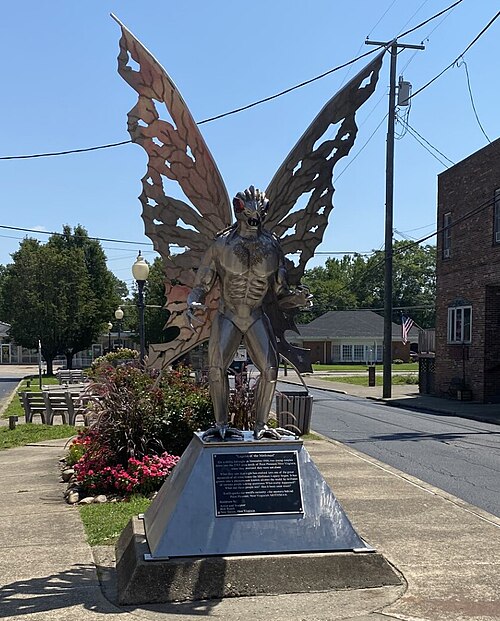
VI. Post-Incident Legacy
In the decades since, Point Pleasant has commodified the anomaly. Festivals, statues, and pop culture adaptations have rendered the Mothman approachable—even humorous. The promise of monetary gain converted fear into novelty.
Yet the anomaly persists. Following major disasters elsewhere, reports of Mothman-like figures resurface. Red eyes. Wings. Silent observation. Always before, an inscrutable omen.
The Anomalous Archivist notes this recurrence without speculation.
VII. Archival Assessment
The Mothman does not fit neatly into classifications of cryptid, spirit, or psychological phenomenon. It occupies a more troubling category: the omen unable to be interpreted in time.
Be it a creature, a projection, or something else is secondary. The record shows that when it appeared, disaster followed—and when disaster struck, it was already gone.
This entry remains open.
Works Cited
Barker, W. H., and Thomas M. Davis. “Reanalysis of the Collapse of the Silver Bridge, Point Pleasant, West Virginia.” Journal of Performance of Constructed Facilities, vol. 13, no. 2, 1999, pp. 84–92.
Keel, John A. The Mothman Prophecies. Saturday Review Press, 1975.
Nickell, Joe. “Mothman: Monster or Misidentification?” Skeptical Inquirer, vol. 26, no. 3, 2002, pp. 28–33.
Radford, Benjamin. Tracking the Chupacabra: The Vampire Beast in Fact, Fiction, and Folklore. University of New Mexico Press, 2011.
Wyman, Matthew. “Point Pleasant and the Birth of a Modern Legend.” Appalachian Folklore Journal, vol. 8, no. 1, 2014, pp. 45–61.
 The Anomalous Archivist
Leave a comment